Agenda / Table of Contents
- Chapter 1: The COTA Crucible – A Stage for Speed and Strategy
- Setting the scene at the iconic Circuit of the Americas and the high stakes of qualifying.
- Chapter 2: The DNA of Dominance – Deconstructing Car Performance
- A deep dive into the “Machine Performance DNA,” analyzing the unique strengths of Red Bull, Mercedes, McLaren, and the surprising Kick Sauber.
- Chapter 3: The Ghost in the Machine – Unpacking the Theoretical Best Lap
- Exploring the tantalizing “what ifs” of qualifying, focusing on Max Verstappen’s staggering untapped potential and the drivers who perfected their laps.
- Chapter 4: The Straight-Line Shootout – Analyzing Top Speed Supremacy
- A detailed look at the velocity kings of COTA and the strategic trade-offs between top speed and cornering grip.
- Chapter 5: The Evolving Battlefield – The Subtle Science of Track Evolution
- Investigating the critical, yet often overlooked, factor of track improvement and its impact on the final qualifying order.
- Chapter 6: A Lap in 25 Parts – The Granular Detail of the Mini-Sector Breakdown
- A sector-by-sector, corner-by-corner analysis of who dominated where, revealing the micro-battles that defined the session.
- Chapter 7: The Final Grid – A Synthesis of Speed and a Look Ahead
- Bringing all the data points together to paint a complete picture of the qualifying outcome and offering predictions for the Grand Prix.
Chapter 1: The COTA Crucible – A Stage for Speed and Strategy
The Circuit of the Americas (COTA) is more than just a racetrack; it is a modern masterpiece of circuit design, a sprawling ribbon of asphalt that weaves through the rolling Texan landscape, challenging drivers and engineers in equal measure. From the blind, uphill charge into the iconic Turn 1 hairpin to the fast, flowing sequence of the “Esses” and the technical complexity of the final sector, COTA is a comprehensive test of a Formula 1 car’s capabilities. It’s a track that demands a delicate balance between aerodynamic efficiency for the high-speed sections and mechanical grip for the slower, more technical corners. The long back straight adds another layer of complexity, forcing teams into a crucial setup compromise: trim out downforce for straight-line speed, or prioritize cornering performance?
It was against this backdrop that the qualifying session for the 2025 United States Grand Prix unfolded. The stakes were incredibly high. In the modern era of Formula 1, where track position is paramount, a strong qualifying performance is often the foundation of a successful race weekend. The one-hour session, divided into its three knockout stages, is a crucible of pressure, a relentless pursuit of perfection where the margins between success and failure are measured in thousandths of a second. For the drivers, it is a test of skill, courage, and mental fortitude. For the engineers, it is the culmination of countless hours of simulation, setup work, and data analysis. The story of this qualifying session is not just in the final timesheet, but in the rich tapestry of data that lies beneath.
Chapter 2: The DNA of Dominance – Deconstructing Car Performance
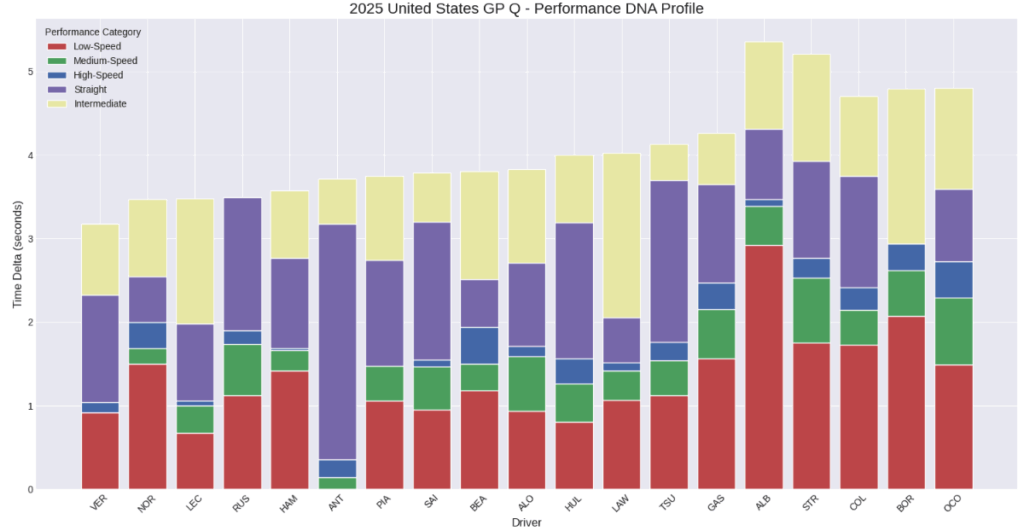
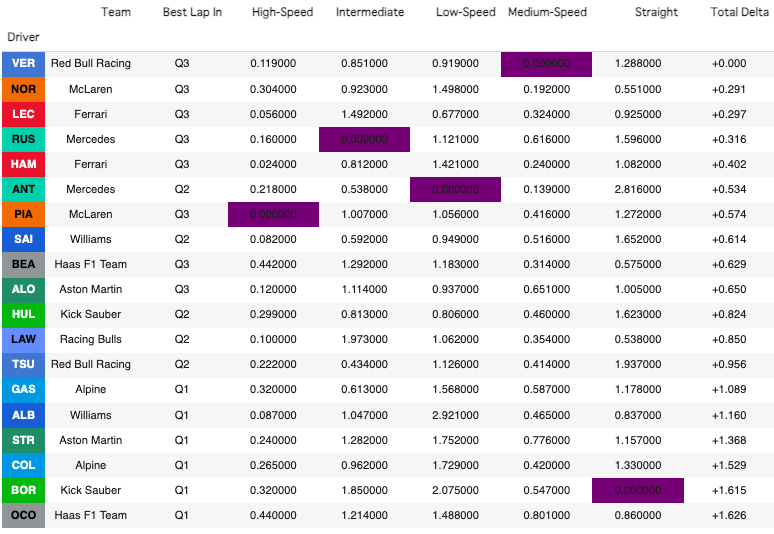
The “Machine Performance DNA” analysis provides a fascinating and incisive look into the inherent strengths and weaknesses of each car. By dissecting the fastest laps into distinct performance categories—high, medium, and low-speed corners, intermediate sections, and straights—we can move beyond the simple lap time and understand how that time was achieved.
- Red Bull Racing (Max Verstappen): The King of Medium-Speed. Max Verstappen’s pole position was built upon a foundation of absolute mastery in the medium-speed corners. These are typically corners with an apex speed between 125 km/h and 200 km/h, where aerodynamic stability and driver confidence are critical. Verstappen’s ability to carry immense speed through corners like Turns 6, 7, and 8 gave him a significant and ultimately decisive advantage. This suggests a Red Bull chassis that is incredibly well-balanced, allowing Verstappen to commit to the corner entry and get on the power early.
- Mercedes (George Russell & Andrea Kimi Antonelli): Masters of the Technical Sections. The Mercedes package revealed its strength in the slower, more technical parts of the lap. George Russell was the benchmark in the “intermediate” sections, while the rookie Andrea Kimi Antonelli was the fastest of all in the low-speed corners. These are the sections where mechanical grip, traction, and a car’s ability to rotate quickly are paramount. The data suggests the Mercedes W16 is a nimble machine, capable of excelling in the tight confines of COTA’s final sector. However, Antonelli’s significant time loss on the straights (a delta of +2.816s) highlights the team’s setup compromise.
- McLaren (Oscar Piastri): The High-Speed Specialist. Oscar Piastri demonstrated the McLaren’s prowess in the high-speed corners, setting the fastest time in this category. This points to a car with excellent aerodynamic efficiency and stability, allowing the driver to trust the car at high entry speeds, a crucial attribute for the flowing Esses in Sector 1.
- Kick Sauber (Theo Pourchaire): The Straight-Line Bullet. Perhaps the most surprising data point came from the Kick Sauber team. Theo Pourchaire’s car was the class of the field on the straights, a remarkable achievement for the midfield team. This low-drag philosophy, while sacrificing some cornering performance, makes the car a formidable weapon in a straight line and could be a key factor in the race, particularly for overtaking and defending.
Chapter 3: The Ghost in the Machine – Unpacking the Theoretical Best Lap
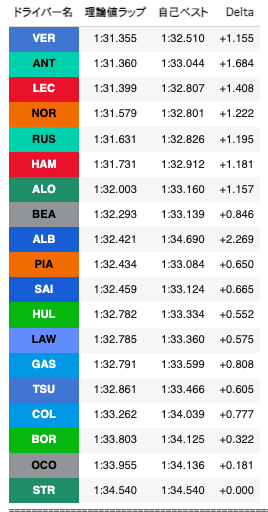
The concept of the “Theoretical Best Lap” is a tantalizing one. By stitching together a driver’s fastest individual mini-sectors from across the entire qualifying session, we can calculate a perfect, idealized lap time—the “ghost” lap that represents the true, untapped potential of the car and driver.
The most staggering revelation from this analysis belongs to the pole-sitter himself, Max Verstappen. His theoretical best was a jaw-dropping 1:31.355, a full 1.155 seconds quicker than his actual pole time of 1:32.510. This enormous delta is almost unheard of for a driver of his caliber and suggests that his pole lap, as brilliant as it was, was far from perfect. It indicates that he left a significant amount of time on the table, likely through small errors or imperfections across different parts of the lap. The fact that he still took pole position with such a large margin to his own potential is a terrifying testament to the raw pace he and the Red Bull possessed.
Other drivers also showed significant untapped potential. The rookie Andrea Kimi Antonelli had a theoretical best that was second only to Verstappen’s, with a delta of +1.684s, highlighting his raw speed but also his struggle to achieve consistency over a full lap. In stark contrast, Lance Stroll achieved a delta of +0.000, a rare feat indicating that his single fastest lap was a perfect amalgamation of his best mini-sectors—a flawlessly executed lap, even if the ultimate pace wasn’t at the sharp end. This data transforms our understanding of the session, revealing the hidden layers of performance and the fine margins between a good lap and a perfect one.
Chapter 4: The Straight-Line Shootout – Analyzing Top Speed Supremacy
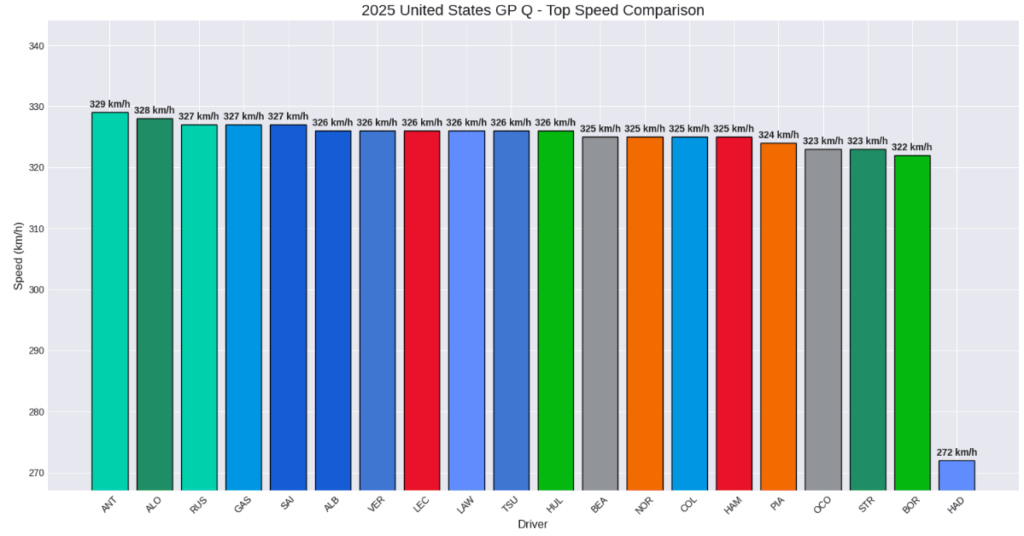
The long back straight at COTA is a critical part of the circuit, offering a prime overtaking opportunity and a clear measure of a car’s power unit performance and aerodynamic efficiency. The speed trap data from qualifying confirmed the findings of the Performance DNA analysis: the Kick Sauber of Theo Pourchaire was the fastest car in a straight line.
This is a significant strategic advantage. In the race, the Kick Sauber will be incredibly difficult to pass on the straights, even with the aid of DRS. It also allows the driver to be more aggressive in attacking cars ahead. Following closely behind the Sauber were the Williams and Mercedes cars, both known for their strong power units and efficient aerodynamic packages.
At the other end of the spectrum, some of the top teams, like Red Bull, were not at the top of the speed trap charts. This reflects their strategic decision to run a higher downforce setup, sacrificing some straight-line speed for better performance in the corners. This trade-off is at the heart of race engineering, and the qualifying data gives us a clear indication of the different philosophies at play up and down the pit lane.
(Image Placeholder: A detailed bar chart comparing the top speeds of all 20 drivers, with annotations highlighting the different power unit suppliers.)
Chapter 5: The Evolving Battlefield – The Subtle Science of Track Evolution
Track evolution is a subtle but ever-present factor in any qualifying session. As more cars circulate the track, they lay down a layer of rubber on the racing line, which increases grip. Simultaneously, the track surface cleans up, and its temperature can change. All these factors contribute to the track getting progressively faster throughout the session.
Our machine learning model calculated that the track surface at COTA improved by an average of 0.012 seconds per minute. While this may seem like a small number, over the course of a 15-minute qualifying segment, it can add up to a significant advantage. This meant that being one of the last cars to cross the finish line at the end of each session was a small but potentially crucial advantage.
This phenomenon adds another layer of strategy to qualifying. Teams must time their runs perfectly, balancing the need to get a clean lap in with the desire to benefit from the optimal track conditions at the end of the session. It’s a high-stakes game of cat and mouse, and a miscalculation can be the difference between advancing to the next stage of qualifying and being eliminated.
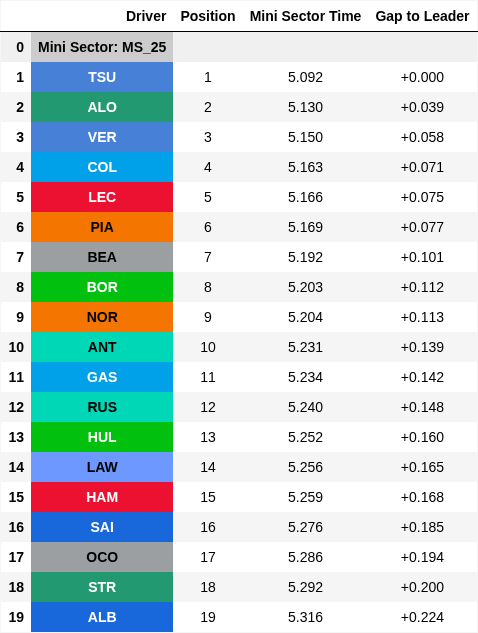
Chapter 6: A Lap in 25 Parts – The Granular Detail of the Mini-Sector Breakdown
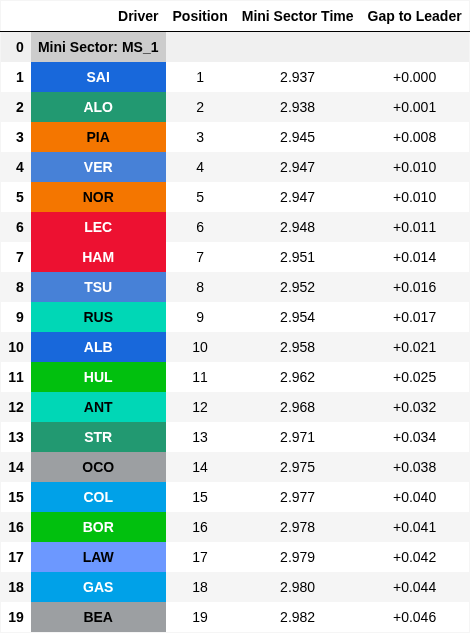
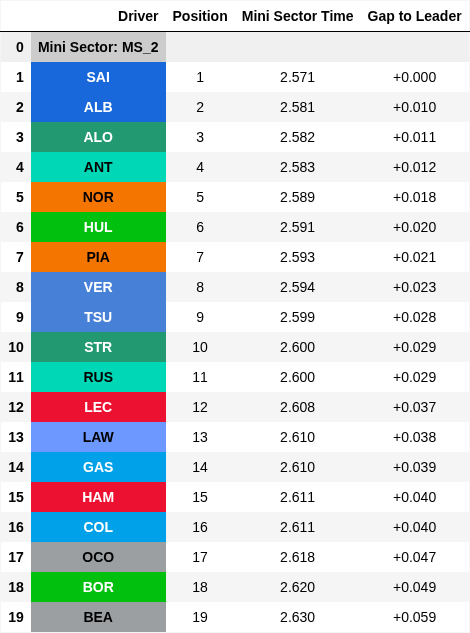
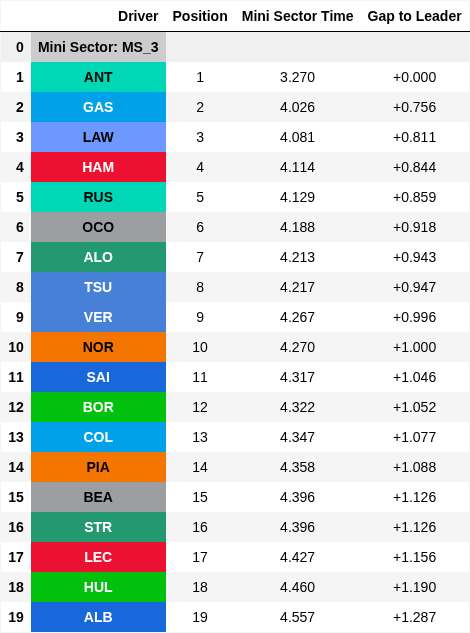
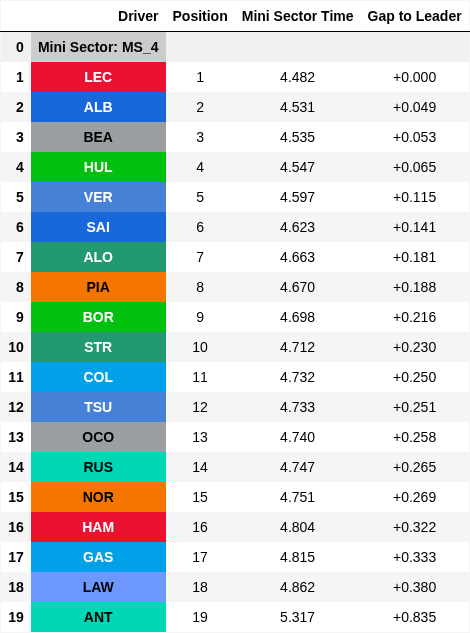
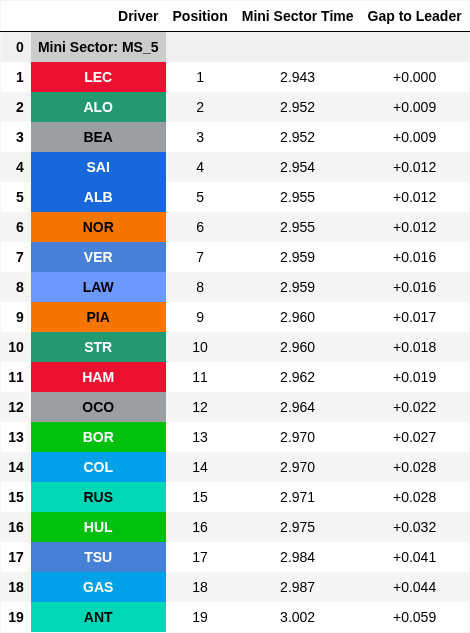
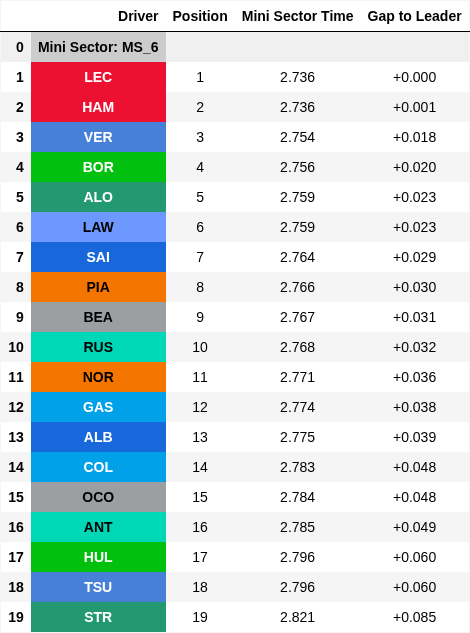
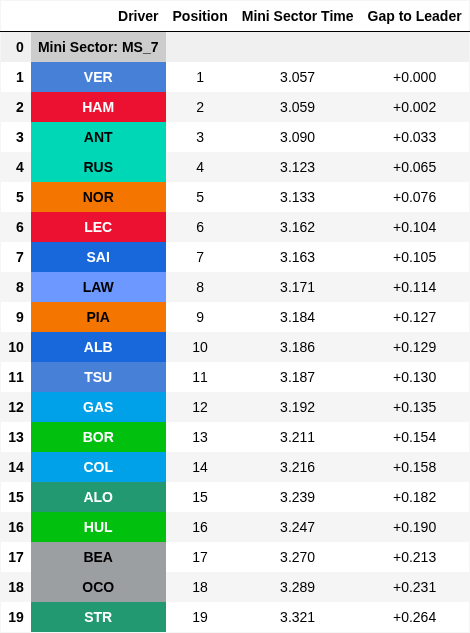
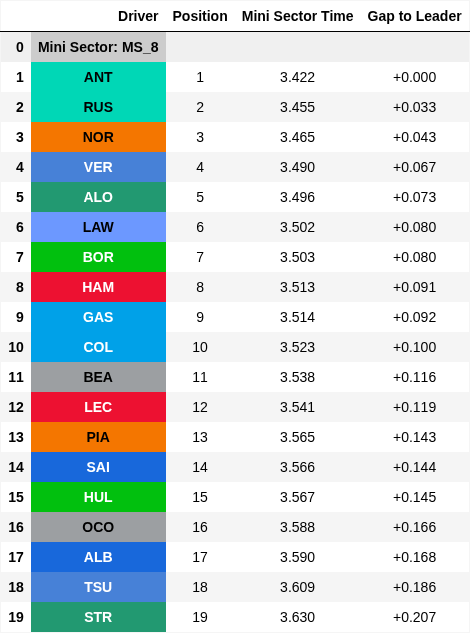
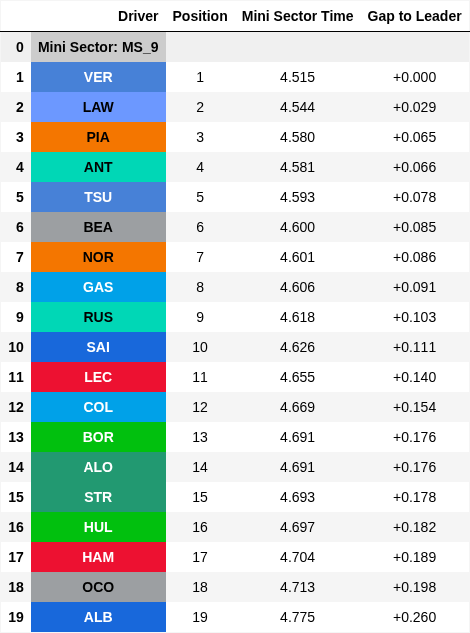
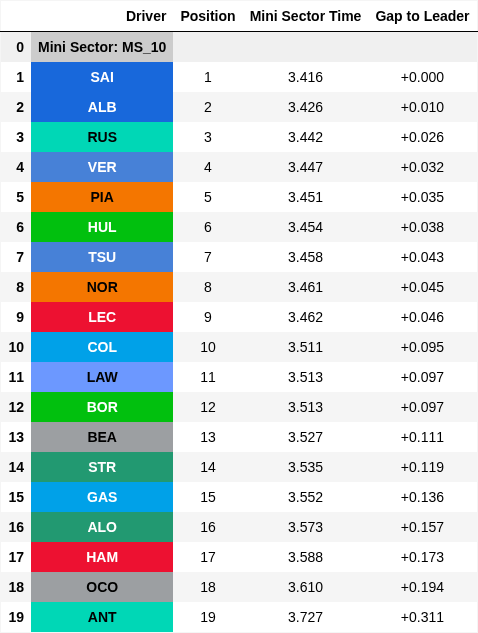
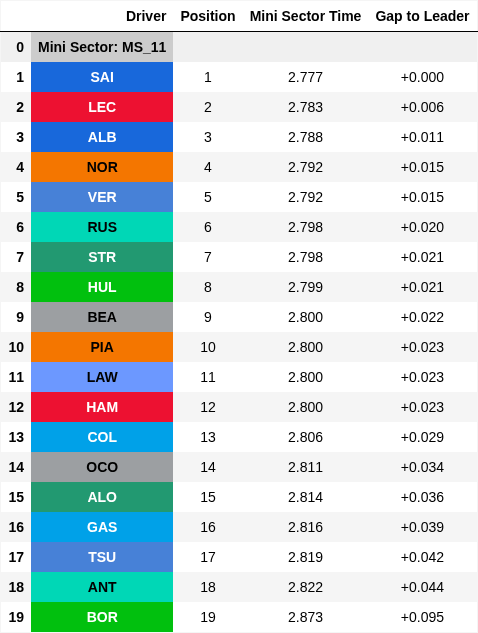
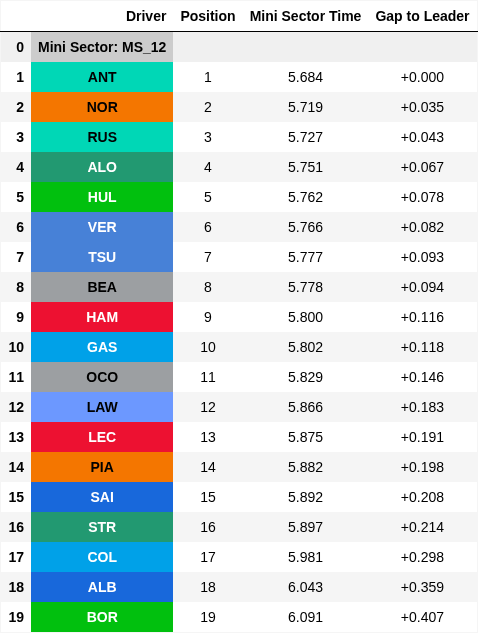
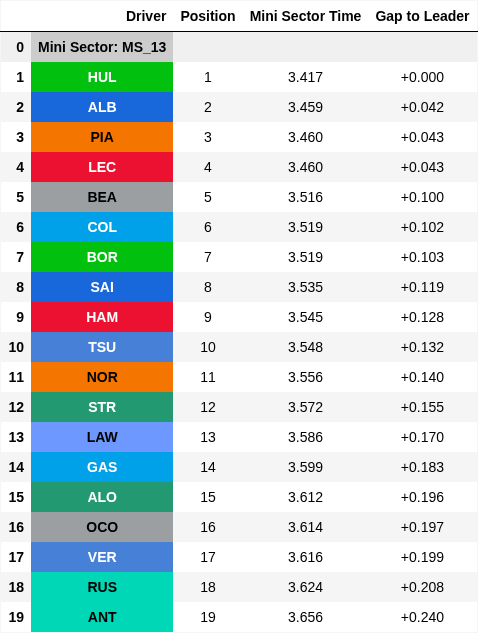
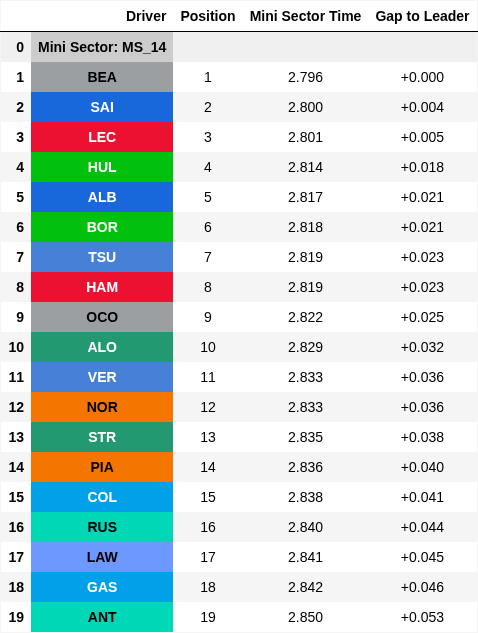
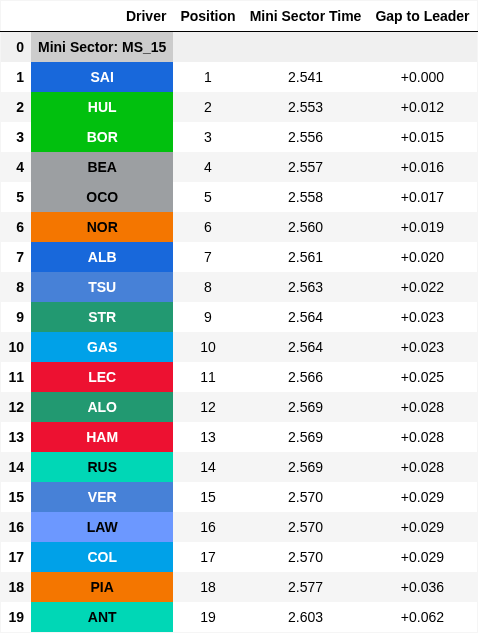
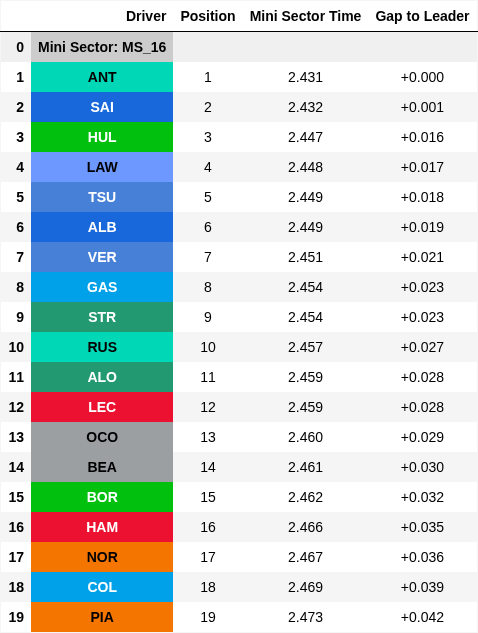
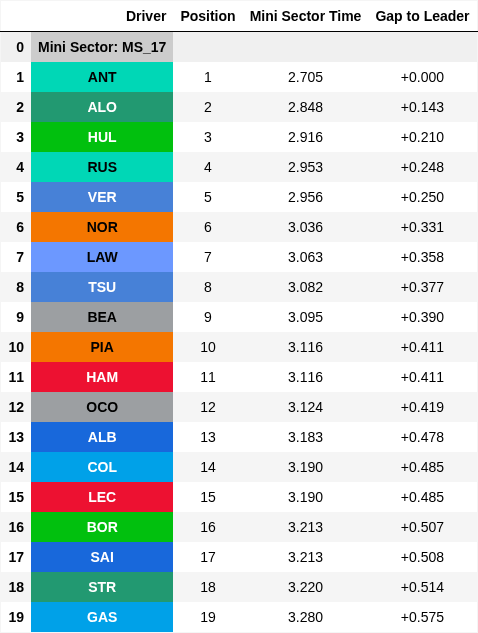
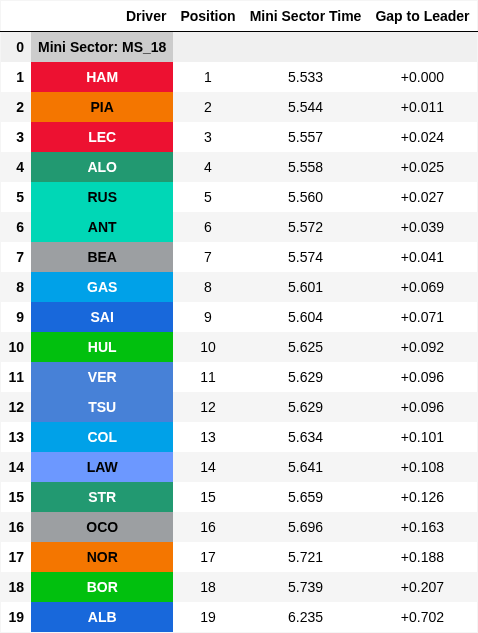
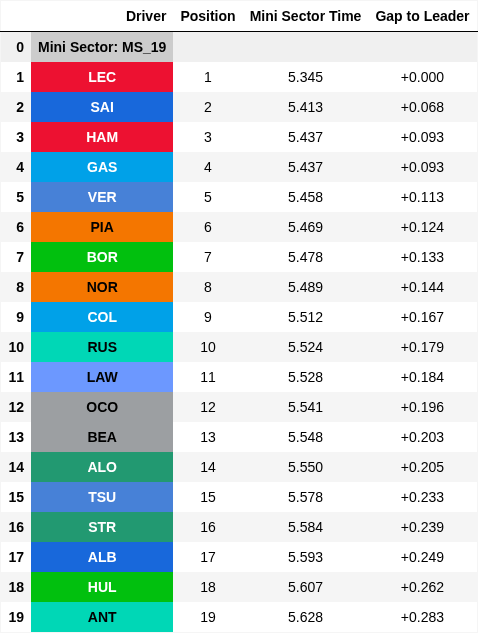
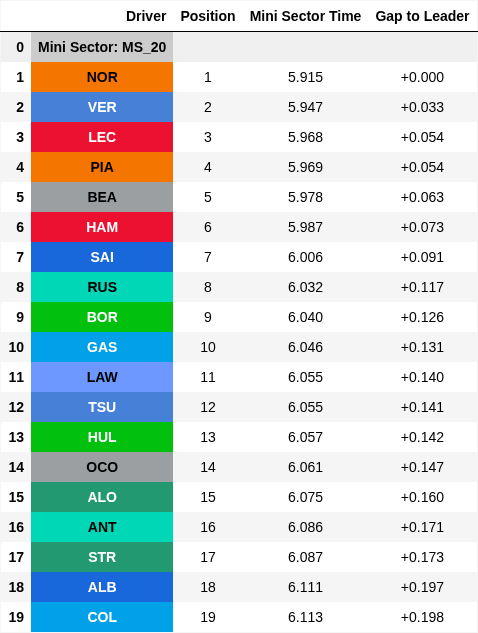
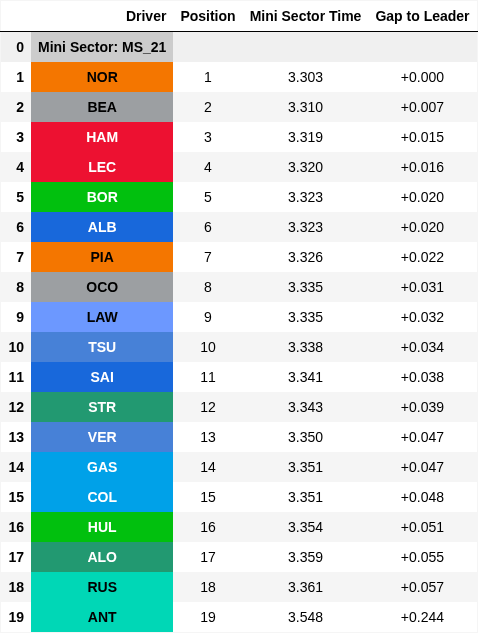
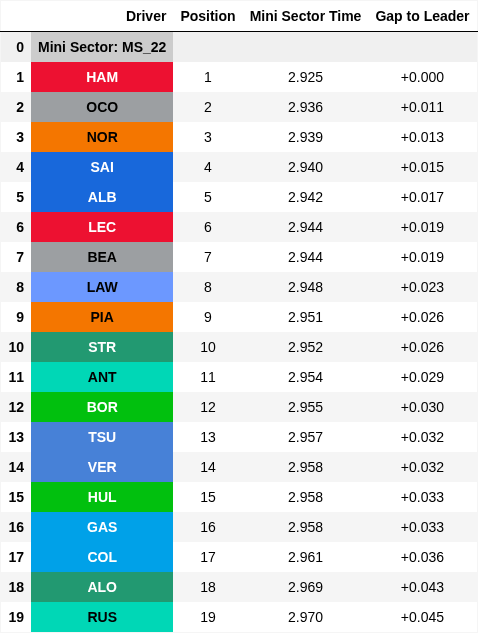
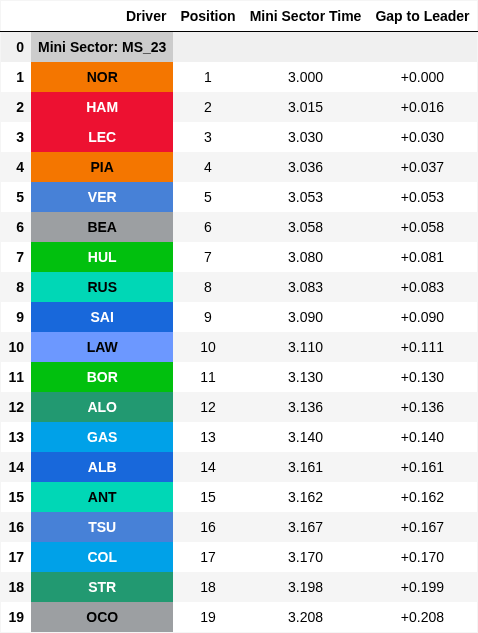
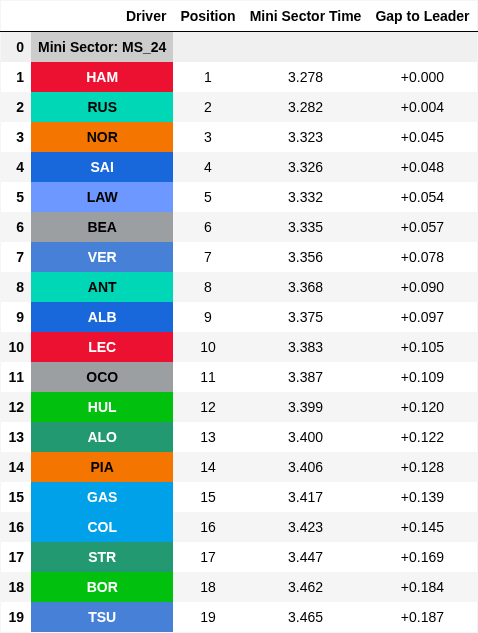
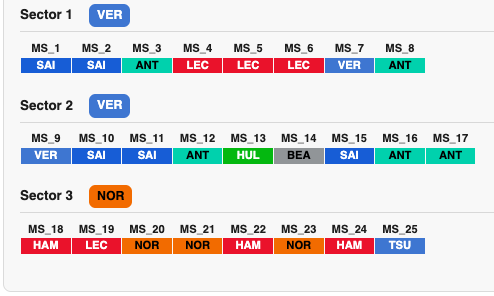
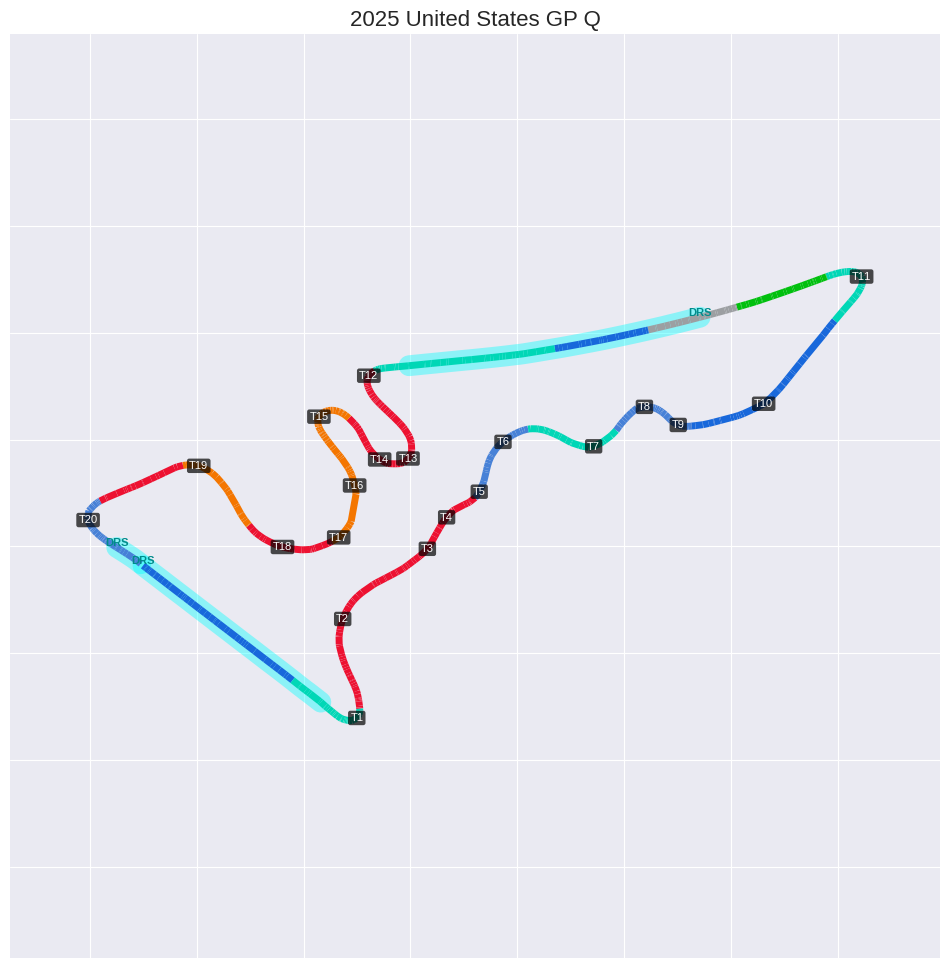
To truly understand where the qualifying battle was won and lost, we must dissect the lap into its constituent parts. Our analysis breaks the COTA circuit down into 25 distinct mini-sectors, allowing us to see with incredible granularity who was fastest where.
- Sector 1 (Turns 1-11): A Mix of Power and Precision. The opening sector is a complex mix of the slow Turn 1 hairpin, the high-speed esses, and the tight Turn 11. The mini-sector data reveals a fascinating story. Williams (Sainz) and Mercedes (Antonelli) were quickest in the initial slow corners, leveraging their strong mechanical grip. However, as the lap flowed into the high-speed esses, Ferrari (Leclerc) and Red Bull (Verstappen) came to the fore, their superior aerodynamic performance allowing them to carry more speed through this demanding sequence. Verstappen ultimately claimed the fastest overall sector time, but the mini-sector data shows it was a closely contested affair.
- Sector 2 (Turns 12-15): The Straight-Line and the Stadium. This sector is dominated by the long back straight, but it also includes the heavy braking zone for Turn 12 and the technical stadium section. As expected, the straight-line specialists excelled here. However, the mini-sector data also revealed the strength of drivers like Hulkenberg in the braking and entry phases of the corners. Again, Verstappen’s overall consistency gave him the fastest sector time.
- Sector 3 (Turns 16-20): The Technical Finale. The final sector is a series of slow, technical corners where car agility and driver precision are paramount. This is where a different set of names rose to the top. Lando Norris (McLaren) was the king of Sector 3, his car seemingly dancing through the tight, twisting sequence. The two Ferrari drivers, Hamilton and Leclerc, were also exceptionally strong here, their cars able to rotate quickly and find excellent traction on the exit of the corners. This is where they clawed back some of the time they had lost to Verstappen in the faster sections of the lap.
Chapter 7: The Final Grid – A Synthesis of Speed and a Look Ahead
When all the data is synthesized, a clear picture of the qualifying session emerges. Max Verstappen’s pole position was a result of his and Red Bull’s commanding performance in the medium-speed corners, combined with his ability to deliver a lap that, while not theoretically perfect, was still faster than anyone else’s.
However, the data also reveals a fascinating and competitive field behind him. The all-around strength of Ferrari, the high-speed prowess of McLaren, the low-speed agility of Mercedes, and the straight-line speed of Kick Sauber all point to a race that could be full of strategic intrigue.
The key questions for the Grand Prix are numerous. Can Verstappen convert his immense raw pace into a comfortable victory, or will his less-than-perfect qualifying lap be a sign of a vulnerability that can be exploited? Can the Ferrari and McLaren drivers use their strength in the slower corners to challenge for the lead? And how will the straight-line speed of the Kick Sauber and Williams cars play out in a race situation? The qualifying session at the Circuit of the Americas has not just given us a grid; it has given us a rich and complex narrative, a tantalizing preview of the Texan thriller that awaits.
コメント